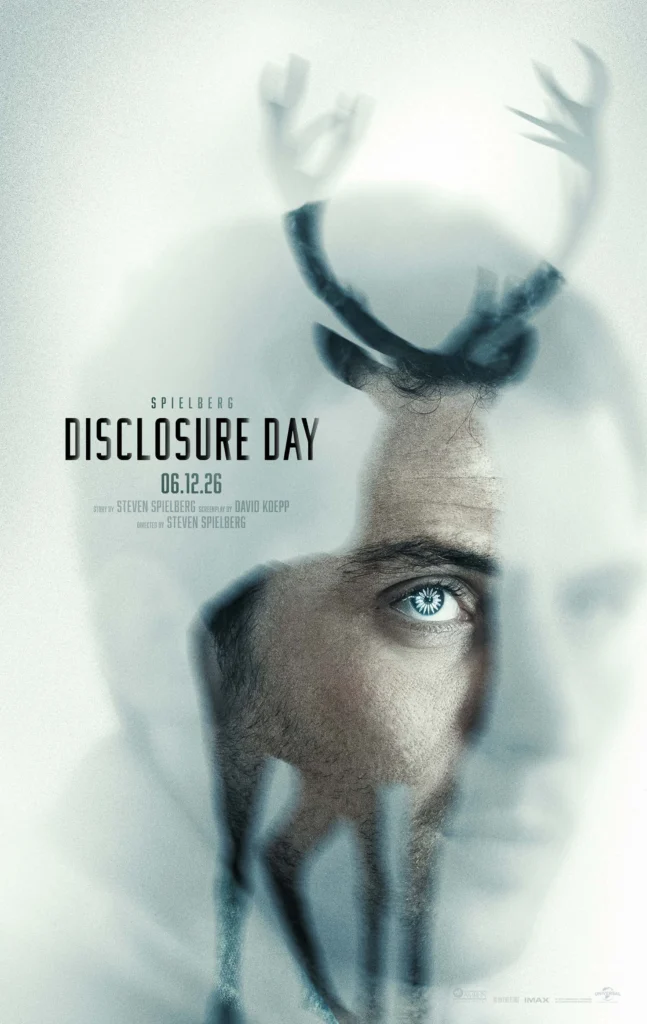
Disclosure Day: A(nother) Metaphysical Movie Review
From Robert V. Tobin
DIRECTOR: Stephen Spielberg
CAST: Emily Blunt, Josh O’Connor, Colin Firth, Colman Domingo
SCREENPLAY: David Koepp
CIMEMATOGRAPHY: Janusz Kamiński
MUSIC: John Williams
* * * * * * * * * *
“Three things cannot be long hidden:
the sun,
the moon
and the truth.”
Gautama Buddha
Few topics trigger as much controversy as the likelihood of life on other planets.
Some believe novels, comic books, movies and tv shows based on science ‘fiction’ are intended to cushion the public’s shock when authorities eventually acknowledge this factual inevitability.
No more prominent film director has so diligently prepared us for this revelation than Steven Spielberg. His first blockbuster – Jaws (1975) – was closely followed by Close Encounters of the Third Kind (1977) and E. T. the Extraterrestrial (1982) thereafter. Both sought to normalize this moment-of-contact by presenting it from the perspective of average citizens more surprised than they should be.
Disclosure Day (2026) imagines this revelation to the next generation, whose exposure to superhero stories and technological breakthroughs makes them skeptical of The Dominant Paradigm. Watching national (in)security used as an excuse for concealment has sharpened their capacity to handle what some think they cannot.
Audiences might not know from the first half of this movie what Disclosure Day is actually disclosing.
Rather than rocket ships and alien lifeforms, it instead introduces viewers to people questioning each other’s intelligence, allegiance and motivations. It depicts those with muddled affiliations and vague agendas trying to manage what is and who owns the truth. It shows the timeless struggle recurring whenever the ones asking the questions also get to decide what constitutes acceptable answers. Hazards emerge from the absence of institutional accountability when personal loyalty is given its own police force, invasive technological capabilities, and little regard for how conformity is achieved.
Sound familiar?
In Spielberg’s view, the only thing scarier than watching an extraterrestrial’s arrival is seeing how quickly paramilitary response assures the power to control overrides the right to know. As fear and panic rise, benefits of chaos avoidance are recognized sooner than their costs.
Disclosure Day opens with news broadcasters describing North Korea’s latest global annihilation threat. Their monotone voices are so deeply imbedded in today’s political psyche that they and their reports seem remarkably unremarkable.
Underlying these stories are strongly-held theories giving birth to separate interpretations at the worst possible time, infecting assessment of what is wrong and when it is dangerously so. Different ways of thinking and connecting perceived as incompatible are actually integral when varied personalities and communication styles intersect.
What distinguishes this movie’s heroes is their adaptability in fast-changing circumstances. The characters played by Emily Blunt and Josh O’Connor concentrate on ‘what is,’ not ‘what if.’ The delicate balance between patience and persistence is maddening to them at times, but they continue to be who they are and do what they must no matter how crazy it may seem to themselves or others. Their ambitious undertaking is a testament to intestinal fortitude, as is each of ours.
They cultivate camaraderie by embracing what researchers call the Resiliency Creed, telling each other “I know you can do it,” and “It’s all going to be ok so whatever happens, don’t you let go!” Challenged by messengers they don’t recognize and messages they don’t always comprehend, they do what is simple but not easy: remain resolute no matter what.
Meanwhile, Colin Firth and his allies in the status quo protection department are so busy creating their own reality, they’re oblivious to the one they’re actually in. Unprepared when the dormant is activated in ways and at times least expected, they denigrate the obvious and reject the unignorable.
Our own personal Disclosure Day arrives every time we accept the undeniable and ponder possibilities beyond self-serving definitions of probable. When the real Facts of Life get liberated from restrictive parameters of our binary left-brain, attention shifts to collective interest in a world where distrust and caring must coincide.
With differences between memories and dreams increasingly difficult to discern, this film underscores subtle distinctions between the political and theological. Coleman Domingo’s character concludes that while God may not be divine, the concept is indispensable to communal wellness. He considers the alternative a lonely way of living when those who think they lost their faith in God actually lost their faith in each other.
Rather than the “opiate of the people” Karl Marx belittled, spirituality is portrayed as a fulcrum elevating us beyond the pursuit of gain, accumulation of wealth and perpetuation of advantage as ends-in-themselves. Empathy is deemed a core evolutionary advantage facilitating co-existence with those upon whom our survival depends.
Other Disclosure Day themes explain Real World autocrats’ difficulty achieving military and/or economic dominance today; among these:
1) The power within is greater than all its other forms;
2) What needs to happen may be delayed, but cannot be stopped;
3) There’s only one place to go, and we’re all headed in that direction; and
4) The most innate drive is the hunger to learn.
Regarding this last point: it is impossible to underestimate the influence of television on my generation, radio on my parents’ and social media on my children’s children. Monetized by advertisers striving to impose marketplace stability, such mediums make the purchase of political – and thus societal – leverage a cost of doing business charged to each of us. Their capacity to cover The Real Story remains leashed, but Disclosure Day foresees truth evading such confinements surely as rogue AI programs overcome their developers’ containment attempts.
The concept of home is a key element of this movie’s crescendo. It is the place we belong, but also a passageway taking us from where we came from to where we are going. Time is relative within this transition as childhood and adult experiences become inseparable.
Spielberg films say we never fully know ourselves or those accompanying us on Life’s journey, and never completely grasp lessons learned along the way. What gets us through, he believes, is companionship – not intellect, influence or other tangibles whose acquisition many devote their entire lives.
Near its end, Disclosure Day’s lead character observes: “There will be no other day like tomorrow.”
The last word uttered before its abrupt ending – “listen” – is good advice on preparing ourselves for the day we welcome other inhabitants of our Universe’s, whenever they arrive. It also happens to be the best way to interact with fellow Earthlings between now and then.
* * * * * * * * * *
Robert V. Tobin is the father of four, stepfather of four, and grandfather of eleven great people who brighten prospects for a world founded upon trust, optimism and loving kindness.