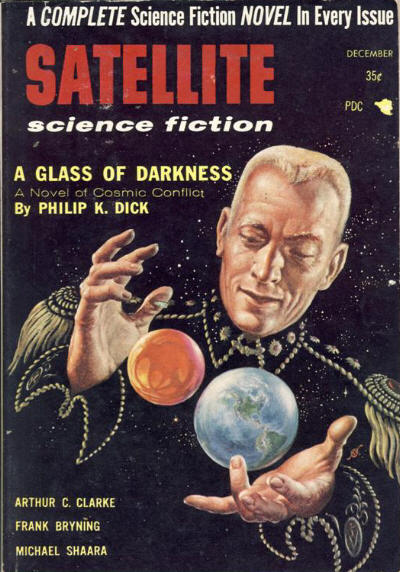
From Anne R. Dick’s book “Anne and the Twentieth Century” :
“Richard received a modest monthly income from a property his mother owned in Quincy, Illinois, which paid for food and rent. If we needed a new car, Richard’s mother would buy one for him. If we wanted to go on a trip, Richard’s mother would send money for the trip….
“I felt uncomfortable that Richard didn’t work and earn money, but there was nothing to be done about it. Richard felt he was too nervous to work.”
From The Point Reyes Light 2016 article by Dave Mitchell on the book: “But Richard was an aspiring poet, and the only people he didn’t feel ill at ease around were other poets—and San Francisco’s bohemians. Fortunately, he and Anne arrived in the city just as the Beat Generation was coming into its own.
Richard started a poetry magazine; it lasted only one issue, but it put him in touch with such poets as Kenneth Rexroth, Dylan Thomas, Robert Creeley and Gary Snyder.”
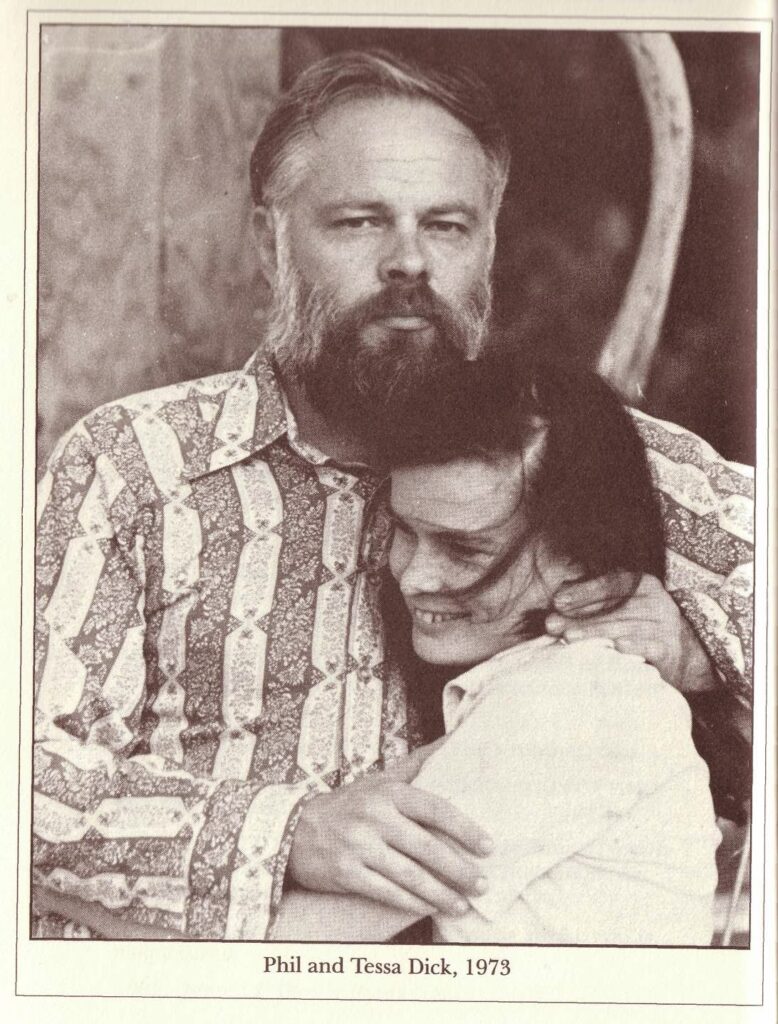
Tessa Dick, fifth and last wife of Philip K. Dick, was married to Phil between 1973 and 1977, through the time he had his infamous visionary experience on 2/3/74. She said:
“He spent more time trying to figure out the experience than he did actually having it,” Tessa reported in a 2017 interview with Miguel Conner for Aeon Byte Gnostic Radio.
Lots more PKD info:
In Film:
Many film adaptations have not used Dick’s original titles. When asked why this was, Dick’s ex-wife Tessa said, “Actually, the books rarely carry Phil’s original titles, as the editors usually wrote new titles after reading his manuscripts. Phil often commented that he couldn’t write good titles. If he could, he would have been an advertising writer instead of a novelist.” Films based on Dick’s writing have accumulated a total revenue of over US $1 billion as of 2009. (Wikipedia)

“Rather than being in the genre of Moore or Roth, The Man in the High Castle more closely resembles the metaphysical fictions of Jorge Luis Borges, whose story “The Garden of Forking Paths” (1941) envisions a labyrinthine world that contains every possible chain of events.” John Gray, The NewStatesman. http://www.newstatesman.com/culture/tv-radio/2016/03/john-gray-philip-k-dick-lost-multiverse-history
“He was the funniest SF writer of his time, and perhaps the most terrifying.” – The Encyclopedia of Science Fiction.
“Many people have never experienced an intense romantic love; they don’t even believe in it. …My romantic commitment to Phil—(most of what I knew about relationships came out of novels) wasn’t easy…” p.244.

“A lot of men idolize the Phil they meet in his writing. I think men need to preserve a little wildness, something that gets more or less stamped out by our culture and by domesticity. If it weren’t for women, men would live very different lives.” Anne Dick, p. 243, Search for Philip K. Dick, revised 2009.
“Many authors have claimed muses throughout history, but rarely has one had such a mythology about it … Valis, according to some is Dick’s interpretation of this essence that speaks to many authors and ensures the progression of not only literature and writing in general, but of all intelligent thought; the sort of muse set up with a firm hand in the progression of the human race’s progression.” Chris Capps (unexplainable.net)
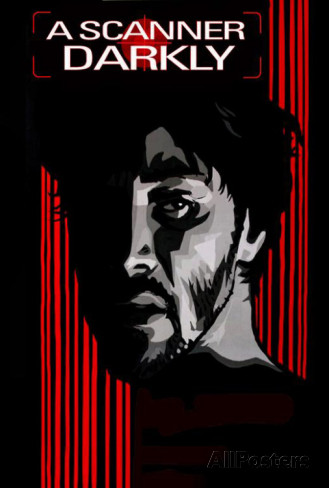
A Scanner Darkly: Richard Linklater’s adaptation is perhaps the most faithful adaption of any PKD movie.
Philip K. Dick, an uneasy spy inside 1970s suburbia:
by Scott Timberg, freelance journalist in LA TIMES.
“During the last years of his life, Philip K. Dick lived in, of all places, Orange County, a Southern California setting that made the life-battered sci-fi writer something of a stranger in a strange land (to borrow from Robert Heinlein) “He kept comparing Southern California to Disneyland,” remembered wife Tessa Dick, “and said it was plastic, wasn’t real. He was used to real cities like Berkeley and San Francisco and Vancouver.”
“To a writer whose primary subject was the slippage between the real and constructed, the place surely also fascinated him as well.”
The Men Who Fell to This Dull Earth:
Beyond.. cover photo:
“Upon the Dull Earth” was originally published in the November 1954 issue of Beyond.
“VALIS” Within VALIS: Philip K. Dick’s Homage to The Man Who Fell to Earth
(VALIS. Dick’s acronym for Vast Artificial Living Intelligent System)
PKD said: “The (Bowie) film (The Man Who Fell to Earth) tremendously impressed me; I just loved it. My use of the film VALIS is my homage to The Man Who Fell to Earth. It was one of the greatest experiences of my life to see that.”
“As (Dick) worked on his massive and never completed Exegesis, PKD continued to think about the film. He refers directly to Bowie five times, including the line quoted at the top of the post.” excerpt from Laurie Frost, Bowiesattva blog – https://bowiesattva.wordpress.com/2012/02/02/philip-k-dicks-valis-and-the-man-who-fell-to-earth-and-duncan-jones/
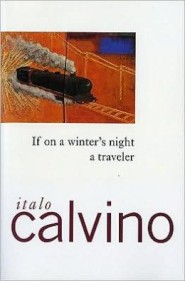
Dick has also been noted as an influence to Cuban born, Italian Italo Covino.
If on a Winter’s Night a Traveler – 1979, Italo Calvino. This is a novel that pretends to be a novel that can’t get started. Through various editorial and other mishaps, every chapter turns out to be not a continuation of the work we are supposed be reading but the first chapter of another one. There are wonderful parodies here, of Borges, of French thrillers, Japanese erotic fiction, political allegories, Latin American magical realism. And in the end the disparate stories do add up to an ironic but tender happy ending. The two readers we have kept meeting manage to get together and stay together.
“The Owl in Daylight” was the sequel to Man in High Castle?
“Second Variety” was made into the movie Screamers. Dick said of his story, published in 1953: “My grand theme — who is human and who only appears (masquerading) as human? — emerges most fully. Unless we can individually and collectively be certain of the answer to this question, we face what is, in my view, the most serious problem possible. Without answering it adequately, we cannot even be certain of our own selves. I cannot even know myself, let alone you. So I keep working on this theme; to me nothing is as important a question. And the answer comes very hard.”
Phillip and Anne’s daughter Laura, and half-brother Christopher (as above), and his daughter from his fourth wife, Isa Hackett are the heirs to the Philip K. Dick Estate.
The Five Wives of Dr. D ; )
1. Jeanette Marlin
2. Kleo
3. Anne Rubenstein
4. Nancy
5. Tessa Busby
(6.) Joan Simpson (Anne states that Joan “could have been his sixth wife.”)
Blade Runner starred Harrison Ford and the film grossed $28 million, but Philip received a mere $1,250, the online magazine Wired reported.
DISNEY (almost) DOES DICK
King of the Elves movie shelved. Dick’s story first appeared in this “Beyond.”
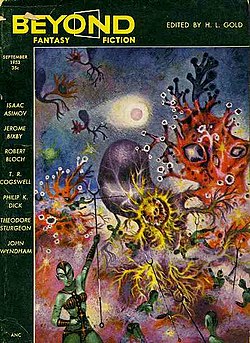
Dick’s only experiment in the fantasy genre becomes the basis for this fantastic and imaginative tale about an average man living in the Mississippi Delta, whose reluctant actions to help a desperate band of elves leads them to name him their new king. Joining the innocent and endangered elves as they attempt to escape from an evil and menacing troll, their unlikely new leader finds himself caught on a journey filled with unimaginable dangers and a chance to bring real meaning back to his own life. (Disney web promo source)
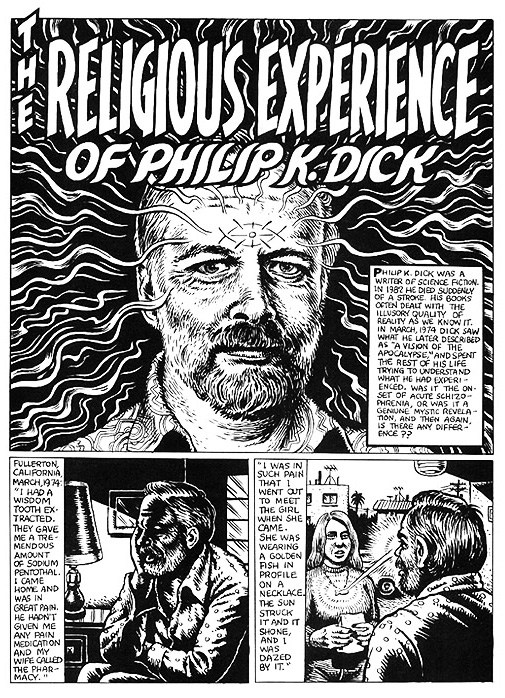
“Crumb, who would later illustrate Bukowski and adapt Sartre in a comic, couldn’t escape the appeal of the literary. In Weirdo #17, published in 1986 and eventually included in the altogether fantastic anthology The Weirdo Years by R. Crumb: 1981–’93 (public library), Crumb illustrated sci-fi legend Philip K. Dick’s now-famous spiritual “exegesis,” his hallucinatory 1974 experience in which he believed to have encountered a God-like presence.” Maria Popova in brainpickings.com
Further reading:
Search for Philip K. Dick (1993, 2003, rev. 2009) Anne Dick. The first biography of PKD ever written (began in 1985).
Flow My Tears, the Policeman Said (1974) awarded the John W. Campbell Memorial Award for Best Science Fiction Novel. And the only Philip K. Dick novel nominated for both a Hugo and a Nebula Award.
Ubik(1969) by PKD. In 2005, Time magazine listed it among the “All-TIME 100 Greatest Novels” published since 1923.
The Android Head Of Philip K. Dick is stolen:
http://www.huffingtonpost.com/2012/06/06/the-philip-k-dick-android_n_1573318.html
Bring Me the Head of Philip K. Dick
http://www.memphisflyer.com/memphis/bring-me-the-head-of-philip-k-dick/Content?oid=3191917
“Philip K. Dick’s Masterpiece Years.”
http://www.nytimes.com/2010/11/23/books/23philip.html?%20Philip%20K&_r=0