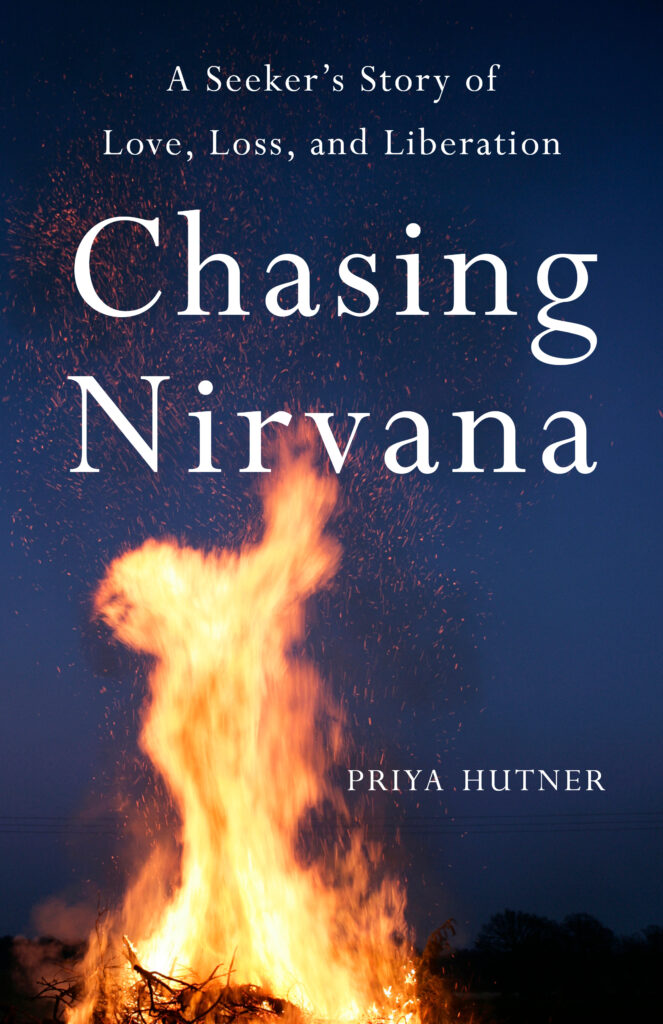
Book Reviews: Chasing Nirvana by Priya Hutner
Review # 1 by J.Macon King
“Ma was the guru, the dispeller of darkness, the one who shone the light on our inner spiritual landscape.” —Priya Hutner
Chasing Nirvana is an intimate self-portrait of a youth and soon, her grown-up-way-too-young woman self, during mostly misspent years, mostly with a Hindu-based cult group. Priya Hutner gives us provocation to consider of what aspects of our own and friends youthful lives were spent, misspent, perhaps repent—and how much was actually our own will. Not parent’s, not society’s, not peer pressure’s, not biology’s three-letter word.
Priya Hutner’s book calls to mind Sands Hall’s confessional memoir, Reclaiming My Decade Lost in Scientology (formerly 2018’s Flunk. Start.) Both writers are now free-spirited, independent and accomplished California Sierras’ ladies (Priya in Truckee, Sands in Nevada City). Sands Hall’s memoir, and Betsy Fasbinder’s “Morning Glory” series interview podcast with her, expresses Sand’s deep regrets, not recriminating against the Scientology cult but against her own rapidly diminishing choices, which seemingly left her without any. Compelled, like Scientology does, to cut off friends and even family who are not completely supportive of Scientology, with no chance of living a normal life, starting a career, a marriage or own family outside the cult.
Priya Hutner’s debut book is journalistic in style (she has been a journalist for years) with little flowering, while Sands’ work is more literary (an MFA’ed novelist\playwright). I also found myself comparing this memoir to (self-taught) Jan Kerouac’s Baby Driver (1981). Jan, the disavowed, denied and neglected only child of the Jack Kerouac, also describes similar (yet cult free) parental bad choices brambling and thorning Jan’s own path of bad choices. Although not a “cult book”, there are certainly similarities to Priya Hutner’s New York-reared-and-geared sex, drugs and rock n’roll, chemical romanced, early pregnancies as young teen, and beyond. Jan’s strong suit in her raucous, wild ride is descriptive imagery, with Kerouacian DNA of stylistic stripped-down lyrical wordiness, pinball-paced with colorful passages. She describes an acid trip that will blow the minds of even those who had responded “yes” to Jimi Hendrix’s “Are you experienced?”
“When [Ma] spoke again, it was as if a different person had taken over her body… ‘God is in the sharing. If you want my truth, you must also take my insanity,’ she said.” —Priya Hutner
A similar transformative moment may be had by the reader of Chasing Nirvana in what may be one of the more “enlightening” chapters, “They Long to Be Close to You.” Priya describes a cult session in which one can glean why so many cult members adored and devoted their lives and children to “Ma”, this outrageous, dictatorial female guru from the streets and Coney Island boardwalks:
“Her gold bracelets helped keep her grounded when she was in a godlike state. I believed them, and I believed that Ma was someone extraordinary with magical, mystical powers and the ability to make our lives better, heal us, and change our destinies.”
The book’s short-chapter (as few as two pages) vignettes lend to the sneaking\peeking-into-a-diary-like read, as they become increasingly disturbing and woeful as the story unfolds. All chapter titles are rock-song based, which is initially fun, but soon the incongruity of being paired with the volume’s nirvana-chasing theme may puzzle readers. Perhaps this titling was conceived intentionally as a rebellious counterpoint to the strict and fun-sucking control of the guru and her ashram, although Lennon’s “Instant Karma! (We All Shine On)” is surprisingly absent.
Reading this, as a father of a youthful daughter myself, I found myself tensing like viewing a scary movie, wanting to cry out, “No! Priya! Don’t follow that weirdo into the old barn with the hanging meathooks and chainsaws!”
What strikes me most about charismatic cult leaders (including some heading well-known sales organizations) are their similarities in mind control as both energizers and energy suckers. We have all experienced this when say, someone walks in the room with all eyes on them. But soon, we feel our insecurities, our energy being sucked away, our blood being drained. Vampires do walk the earth. Energy Vampires.
It’s as if all cult gurus had the same manual “Rules for Radical Cult Leaders.” Attract the lost, the hurt, the insecure, the gullible and curiously hopeful seekers — by ideas, promises, presence, confidence, looks, sex appeal, religious, higher power, mystical hooks, prophecies of nirvana and\or the Four Horsemen. Provide direct brutal “truths” of seekers’ weaknesses, isolation from outsiders, to soon strip followers down to build them back, indoctrinated and molded to the leader’s concepts. AKA brainwashing.
Next, control them by alternating currents of extreme ego boosts (“You’re my favorite.” “I’m considering you for leadership.” “I love you. I only want what’s best for you.”) with the deadly D’s: derision, demeaning disparagements, doses of disappointment in them. (‘You didn’t do it right.’) Priya: “I felt like a bean in a pressure cooker with a lid that wasn’t on properly.”
Finally, get lots of love, sex, money, control of all aspects of followers, often drugs, and for some, control of life and death. Jim Jones People Temple comes to mind. Oh, and Satanism.
Caution: Don’t try this at home.
by J.Macon King
Transparency note: King has performed literary readings with Priya Hutner, Sands Hall and Betsy Fasbinder. He regretfully did not know Jan Kerouac, although he did write of her and other wayward folks in his novel “Circus of the Sun” and two of his friends had close relationships with Jan. King wrote of his own cult experiences in his humorous short memoir, “20 Feet from Enlightenment: A Coming of Sage Story.” Originally published in Sensitive Skin magazine and republished here.

Review # 2 by Robert V. Tobin
Chasing Nirvana reveals how intelligent people get duped by scammers, charlatans, bullies, and fervent delusionists. The correct answer to the question “what were they thinking?” is: they weren’t.
The memoir’s author, Priya Hutner, says those who join cults “are loners and losers.” This catchy alliteration doesn’t explain why doctors, lawyers, accountants and other capable people like herself went in, stayed in, and failed to leave even after they, their children, and others they loved were abused verbally and otherwise by those made drunk by power.
It’s no coincidence the sports term ‘fan’ comes from the word ‘fanatic.’ Blind allegiance to cult leaders is forged by emotional attraction to reflected glory, not cogent insights based upon rigorous intellectual analysis. The ego’s reluctance to admit mistakes further delays recognition of irreparable harm until too late for its victims, but never soon enough for its perpetrators.
“Gradually, and then suddenly.” That’s how a character in Hemingway’s The Sun Also Rises described how he went bankrupt. It also depicts how Hutner discovered the hard way – is there another? – that expecting someone else to fix everything solves nothing, only making it worse for everyone involved except – of course – the supposed fixer.
Exploiting human vulnerabilities is not a hallmark of compassion and bears no relation to spirituality, regardless of how fervently claims are made that “it’s for your own good” … and especially then.
Just ask Priya Hutner.
by Robert V. Tobin