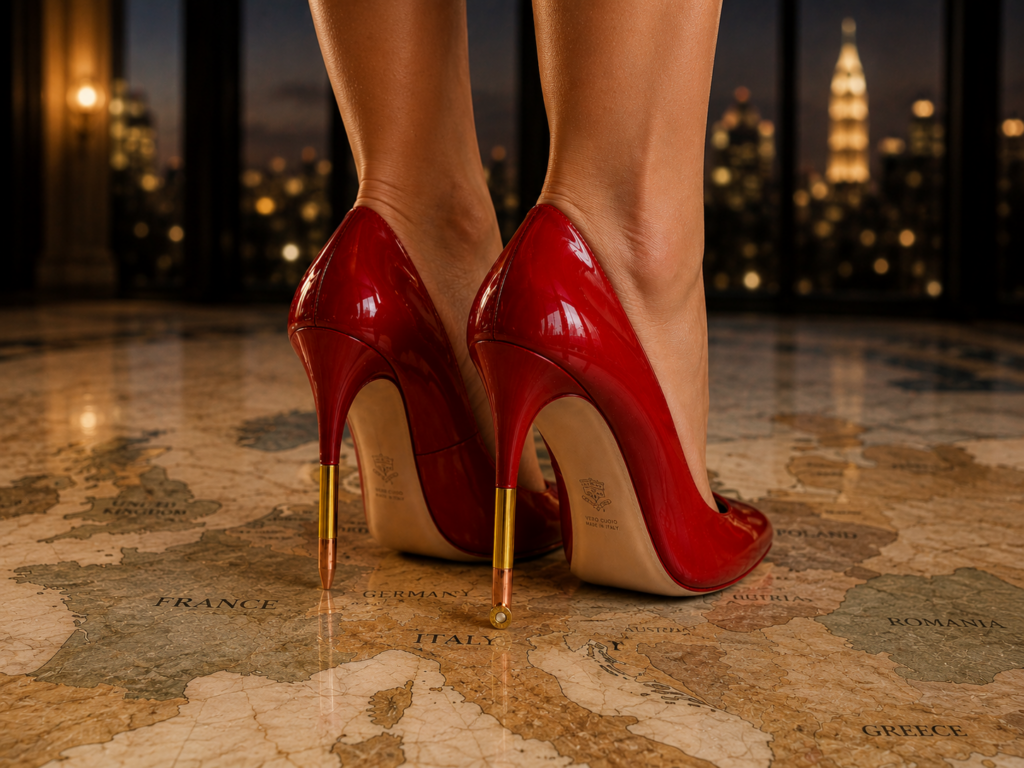
High Heels and Hollow Points
or The Girl Who Knew Too Little
by Dianne Reeves Angel
Whoever said a liberal arts degree was a waste of time and money deserved to be waterboarded with boxed Chardonnay. I landed a dream job precisely because I majored in English literature, with a minor in creative writing.
I joined Castlemont Productions as a story editor. My days were spent reading screenplays, writing synopses, and evaluating whether a story had that elusive thing: commercial potential. I was, quite literally, getting paid to read and critique. It was heaven.
After a year buried in screenplays and book galleys, I was promoted to Vice President of Project Development. Suddenly, I wasn’t just offering notes. I was flying to Paris and Cape Town with our Executive Producer, Robert Carlyle, staying at The Savoy in London, The Meurice in Paris, and even a castle in West Berlin. Carlyle was a mysterious, peripatetic figure, equal parts producer and world traveler, the kind of man who seemed to know the maître d’ in every grand hotel and the concierge in every capital. We pitched passion projects to studio executives who glanced at their watches, and sat across from talent agents who could smell fear like blood in the water.
It was glamorous, yes, but also a high-wire act. One misstep, one poorly chosen script, and the consequences could be dire. Development deals didn’t come cheap, and championing the wrong project could waste hundreds of thousands of dollars and months of effort. Worse, it could erode our credibility in an industry where perception is everything. The whispers traveled fast: she doesn’t have the eye, she can’t close, she’s in over her head. But I wasn’t. And for a bookish California girl with a fondness for a good story, it felt like stepping behind the curtain of a world I’d only ever imagined.
Every morning, I stopped by Gordon Harrison’s suite downstairs to collect telexes from around the globe; these brief communications were the lifeblood of our global film endeavors.
Gordon’s office seemed oddly out of place in this building of film producers and writers, as if a fragment of Mayfair had been airlifted into the middle of Beverly Hills. Gordon himself was a mystery. A cousin of my boss’s wife, he rented the suite below ours. I never knew what he did for a living; he never offered, and I never asked. When I gave it any thought at all, I guessed he was either an accountant or an estate attorney. Carlyle once described him as an “international consultant,” without further elaboration. The setting of his office seemed to confirm it.
The space exuded the air of a private British men’s club, complete with mahogany-paneled walls, tartan wallpaper, and the scent of leather and pipe smoke that lingered in the air. A pair of leather captain’s chairs flanked a fireplace that hadn’t been lit in years, and antique maps hung alongside pastoral portraits of equestrians at the hunt in gilded frames. It was a low-lit affair and unnervingly still, as if any sudden movement might disturb the order of things. Despite these contrived trappings of British aristocracy, it bore no clues as to what Gordon did for a living. There was no signage on his door. No business cards on his desk. And more telling, no visitors.
The man himself, likely in his early fifties, bore an uncanny resemblance to E. Howard Hunt of Watergate infamy, down to the neatly parted silver-blond hair and pallid complexion. His wardrobe was strictly Ivy League: flawless navy blazers, gray flannel slacks, polished brogues, and a fondness for school ties. Everything about him suggested studied precision.
The thaw between us began to melt when Gordon started showing up for after-hours cocktails in our suite of offices. He brought the ice in an elegant, top-stitched leather bucket that looked like it belonged in an Ian Fleming novel. We supplied the bottle, our beloved Johnnie Walker Red Label Scotch.
“Is it the cocktail hour?” he’d ask, loosening his tie just enough.
Our finance guy, Gary Romano, would pass him a crystal glass. Bob Carlyle launched into a Jerry Lee Lewis-style boogie-woogie piano riff, and Gordon would ease into a chair, composed and sipping his scotch slowly. He never said much. But the temperature always dropped a few degrees when he walked in.
The first crack in Gordon’s unremarkable façade appeared one morning after I’d popped downstairs to collect the telexes.
“Good morning,” I said, sorting through communiques, half paying attention.
He looked up from his desk and gave me a brief, courteous nod. “Morning,” he said dryly. “More bad news from Zurich?”
I laughed. “No drama today. Just routine, boring stuff.”
“Boring is underrated,” he said, then paused. “You’ve never seen the vault, have you?”
I glanced up from my papers.
“Come on. I’d like to show you my collection.”
I assumed he meant wine. Or first editions. He led me down a short hallway to a door, an actual steel-reinforced vault, and spun several combinations, clicking right, left, then right again.
The room was as cold as a meat locker. Along the back wall gleamed a weapons arsenal worthy of a Bond villain. Gordon stood beside me, hands clasped behind his back like a museum curator. “That one,” he said, nodding toward a slender black tube nestled in velvet, “is a Bulgarian umbrella gun. Fires a single pellet of ricin. Not very sporting, but effective.”
I was fascinated, “That’s what killed Georgi Markov, right? The Hungarian dissident, stabbed on Waterloo Bridge?”
He glanced at it. “Not this one. But same specs.”
Then, with a slight smile, “You know your history.”
“I was a copy editor at Guns & Ammo,” I said.
“No kidding?” He looked mildly impressed. This was quite possibly the first time he’d considered I might know what I was talking about.
He moved on. “Lipstick pistol. Soviet issue. The infamous ‘Kiss of Death.’ Fires a .45 caliber round.”
I lifted the lipstick pistol with care, marveling at the fact that something so chic could double as an execution device. Next was a fully weaponized leather briefcase.
“Opens from the side. Fires a submachine gun when the handle is pressed. German engineering.”
“Nice for business travel,” I said.
He gave a rare chuckle, low and short.
It was an astonishing array: pens masqueraded as silencers, lighters concealed cameras, binoculars doubled as dart guns, and one sleek cigarette case hid what Gordon offhandedly described as “a short-range acoustic disruptor.”
I stared at the cache of weapons and knew one thing for certain: Gordon was no estate attorney.
The receding hairline, the monotone voice, all camouflage. Beneath it was a man fluent in the language of ballistics, a figure who probably operated in back rooms and borderlands, a keeper of secrets.
From that day forward, I could no longer picture him drafting trusts. I could only imagine the kinds of clandestine operations he might be running, and God knows what else. Was he CIA? Former-CIA? And who exactly were buying his wares? Despots in an African nation? Counter-revolutionaries in South America? I had a million questions, but knew intuitively that I shouldn’t ask them.
When I mentioned my upcoming trip to London to meet with Oscar-winning Israeli director Zvi Menachem, Gordon suggested I dine at the Lowndes Hotel, his preferred London establishment. He advised me to wear smart business attire and “see what developed.”
A week later, I found myself aboard a British Airways flight bound for London, my first-class ticket tucked safely into my handbag. The trip already felt improbably glamorous. My seatmate turned out to be one of Britain’s most celebrated actresses, who greeted me warmly and then proceeded to call me “Shirley” for the remainder of the flight.
“No, it’s Sally,” I corrected her.
“Of course it is, Shirley,” she replied, waving away the distinction and signaling for another glass of champagne.
Somewhere over the Atlantic, after several flutes of champagne and increasingly outrageous anecdotes, she confided that her current husband was nearly twenty years her junior.
“Now, Shirley,” she said, leaning closer, “I know he’s only interested in my money and my fame. But really, dear, the man’s a wonder in the sack. My money has never been better spent.” She hiccupped loudly.
Having settled the matter of modern marriage, she immediately changed the subject.
“Tell me, Shirley, have you got any juicy parts for me in any of your projects?”
By the time we landed at Heathrow, I had consumed more complimentary champagne than was prudent and surrendered any hope of convincing her that my name was Sally.
Twenty-four hours later, jet-lagged but exhilarated, I entered the Lowndes Hotel in central London.
The Lowndes Hotel dining room in Belgravia presented itself as a study in contrasts. The space was unexpectedly bright and airy, elite in its appointments, with round cocktail tables throughout and the palest yellow banquettes lining the walls. As Somerset Maugham might have noted, it was remarkably sunny for such a shady place. The floral arrangements were nothing short of spectacular, filling the room with a soft sweetness that clashed delightfully with the murmur of serious conversations. The maître d’ led me to my table for one, where I settled in with a cup of Irish Breakfast tea, observing the curious atmosphere. The clientele was predominantly male, many with the practiced world-weariness of men who’d seen a few coups go sideways. Most sat alone, conducting business over landline telephones brought to their tables by attentive waiters.
For my part, I wore my favorite luncheon ensemble: a wool kilt, a silk blouse, and navy velvet blazer, with a string of Mikimoto pearls around my neck. It was the effortless look of a Seven Sisters school graduate who hadn’t quite grown up. I’d spent the better part of the fall perfecting it. In my mind, it suggested family money, good schools, and generations of cultivated confidence.
It worked like a charm.
As I picked at my Caesar salad, I became aware of the male patrons glancing in my direction, clearly puzzled by my presence in this environment of swarthy operatives. The dining room of the Lowndes Hotel seemed to be neutral ground where secreta agents from MI-6, Mossad, and the KGB could conduct their business without interference. I kept scanning the room, straining to hear the conversations around me. Across the room, a man folded his napkin with precision. Our eyes met for half a second. Then he looked away. I repeated my performance later that week, causing a subtle disturbance in the balanced ecosystem of the Lowndes Dining Room once again.
Perception is a powerful thing. With the proper lighting and the right tailoring, anyone could appear to belong to this clandestine game. In the Lowndes dining room on those two afternoons, the entire room seemed engaged in a silent masquerade. The silver domes over the dishes gleamed as if they might conceal microfilm, and the floral displays looked less like decoration than coded bouquets from some discreet embassy florist. Even the silences felt orchestrated, each pause delivered with the precision of a le Carré exchange.
A few of the men at neighboring tables fascinated me. They weren’t the polished Mayfair financiers I’d expected. They were darker, heavier, with accents I couldn’t quite place—swarthy men in grayish suits that had become shiny at the elbows, others with shirts unbuttoned to the sternum, their chest hair bristling. Their laughter was low and guarded, their glances sharp, assessing. Even the maître d’, gliding past with that solemn, expressionless face, might have been a courier, waiting for the signal to move.
I fancied myself a junior agent on assignment, though no one had bothered to tell me what the mission was. My only cover was a leather portfolio and the confidence to order a Caesar salad and sole meunière as if they were code words.
That was the genius of the room: it coaxed you into deceiving yourself. Graham Greene would have found a whole novel in the weariness in one man’s eyes, the way he crushed a cigarette as though silencing a confession. Le Carré would have created an entire chapter from the nervous flick of a wrist, the sudden stillness that came with the waiter hovering too long.
It’s incredible what people will believe if you wear an expensive silk blouse and keep your mouth shut.
I returned to Castlemont, jet-lagged and weary, and made a beeline for Gordon’s office, dying to tell him everything. He laughed loudly. It was a new side of him. “Sally, I’ve been getting phone calls from London all week. They all wanted to know who you were.”
My eyes widened.
“One guy was convinced you were a shadow player and demanded I reveal your identity. I told them you were a harmless film executive and posed no real threat.” He was still chuckling. I felt like the cat who swallowed the canary.
Decades later, after the introduction of the internet and with some determined sleuthing, I learned that Gordon Harrison was directly associated with Edwin P. Wilson, “former CIA Agent and Naval Intelligence Officer, who was convicted in 1983 of illegally selling weapons to Libya,” according to The New York Times. After further research I discovered he was a known associate of Frank Terpil, the nefarious CIA defector-turned-fugitive. Terpil fled the United States to Cuba to avoid a fifty-year US prison stretch for illegal arms sales and covert operations gone rogue. His client list read like a dossier of brutality: Idi Amin, the Ugandan dictator who butchered hundreds of thousands of his people, and Muammar Gaddafi, Libya’s mercurial strongman known for torture chambers, terror plots, and public executions.
These revelations cast my lunch at the Lowndes in a new light, suggesting deeper layers to the intrigue in which I participated.
As I reflect on this adventure, it occurs to me, far too late to do anything about it, that Gordon might have been playing an elaborate joke on me. After all, I was a babe wandering through those manicured geopolitical hedges, tended by gentlemen who trafficked in hardware and hearsay. Were they actually watching me—or was I simply projecting drama onto a room full of men who’d rather be plotting a coup?
And those mysterious phone calls Gordon claimed to receive—calls from his CIA brothers-in-arms wanting to know who the American woman was. With time, distance, and the aid of a retroactive reality check, I now suspect the only person curious about me … was me! For all I know, Gordon was on the line with his dry cleaner.
I’m reminded of that delicious little story by Saki, “The Open Window,” and its devastating closer: “Romance at short notice was her specialty.” Perhaps I was the protagonist’s nervous visitor, being expertly taken down the proverbial rabbit hole. Maybe Gordon, in his quiet, mysterious way, was the story’s imaginative little Vera of the covert weapons trade.
But let’s be honest: if it was a farce, it was stylish and ever so slightly mean-spirited. Just a jolly middle-aged arms dealer having a laugh. And I fell for it—heels clicking, handbag swinging, fully committed to the part.
Silk blouse, pearl necklace.
Everyone looked convincing.
Including me.
END
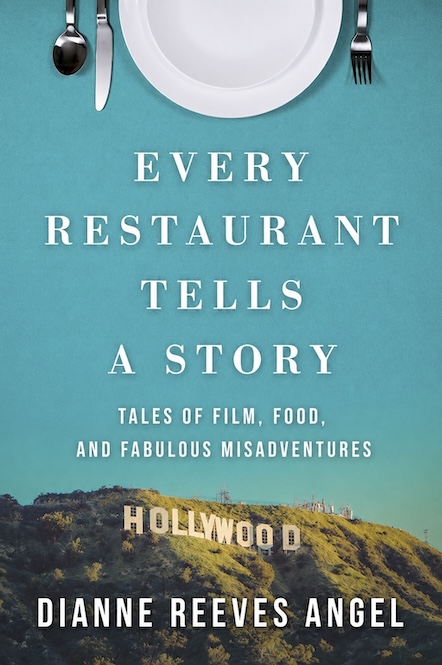
Excerpt from Every Restaurant Tells a Story – Tales of Film, Food, and Fabulous Misadventures, by Dianne Reeves Angel copyright 2026.
“A collection of film industry insider stories with characters who leap from the page ready for their close-ups, Mr. DeMille, international intrigue, Michelin dining to die for, icy cocktails, the near green-lit projects and tailspins back to basement offices, midnight diners and unemployment lines — all that is Hollywood. Ms. Angel’s humor as, “This blonde bombshell sounded like Elmer Fudd on helium” made me laugh so hard I woke up my wife at 3 AM.” J.Macon King, Mill Valley Literary Review.
About the Author
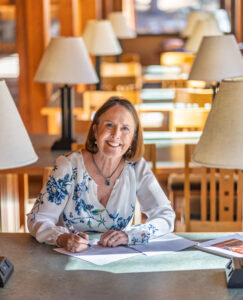
Dianne Angel’s career spans the entertainment and technology industries. In the 1970s, driven by her dream of becoming a film producer, she served as Vice President of Project Development at Z/T Productions on the Columbia Pictures lot. There she wrote the screenplays James Barry and Berlin, with Robert Townsend attached as Executive Producer.
She later developed Weekend Fathers for CBS Television with film producer, James Keach. Although these projects were never produced, they provided the foundation for many of the stories that would later inspire her fiction.
In the early 1990s, Dianne transitioned to Silicon Valley, where she built a successful career as a Human Resources executive in the high-tech industry.
Her poetry, exploring themes of human frailty and triumph, has appeared in Moonshine Ink and Synchronized Chaos. Her book reviews have been published in several international literary journals. Dianne holds a B.A. degree in English Literature from UCLA. She is the author of Every Restaurant Tells a Story and is currently at work on her second book, Viola Mae Bounting. www.dianneangel.com