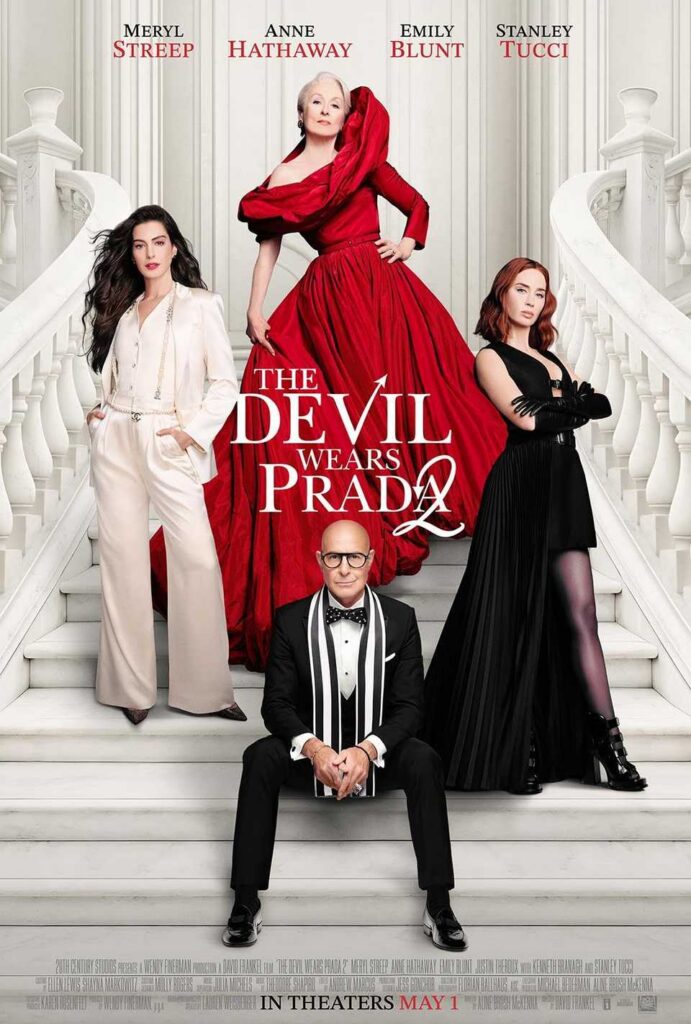
A(NOTHER) METAPHYSICAL MOVIE REVIEW
From Robert V. Tobin
DIRECTOR: David Frankel
WRITERS: Aline Brosh McKenna and Lauren Weisberger
MAIN ACTORS: Meryl Streep, Anne Hathaway, Emily Blount and Stanley Tucci
DIRECTOR of PHOTOGRAPHY: Florian Ballhaus
At its surface level, The Devil Wears Prada 2 (2026) fulfills the promises of its 2006 predecessor: engaging story, splashy outfits, snappy dialogue, contemporary soundtrack, and celebrities appearing as – who else? – themselves.
PRADA 2’s four main characters have evolved in the twenty years since we met them: they, like us, became more of who they already are and always were. Assets and deficits, hard spots and soft, attractions and aversions are more deeply ingrained, era and culture more inseparable, and insecurities more noticeable except to their owner.
Also like us, they are inclined to double down when other alternatives are advisable. Ignoring signs nearly as obvious as the one faced by the Cowardly Lion in the Wizard of Oz – “I’d turn back if I were you,” they are slower to reach his straightforward conclusion: “So would I.”
The question is not whether this movie is a cautionary tale, but rather: which one(s)?
Fashionista eye candy adorning beautiful people assembling on Long Island, Lake Como or the Met Gala staircase recall an idea in Mark Twain’s aptly titled Roughing It borrowed from William Shakespeare: if it is glittering, it’s definitely not gold.
It is no mere happenstance this film’s compelling storylines culminate beneath The Last Supper, one of da Vinci‘s few and most famous paintings. Deceit and betrayal, ego and eccentricity, profit and loss are blithely dismissed by characters struggling to appear – but not actually be – cordial. Biblical admonitions resonate no more here than elsewhere as subordinates treat those reporting to them as poorly as they are treated by their bosses.
PRADA 2 captures how much and little has changed in the decades since PRADA 1’s release. In the interim, ‘the end justifies the means’ went from a Wall Street motto to a cultural mantra. Opulent displays of wealth however acquired, while never quite the sin they supposedly were, went from guilty pleasure to guilt-free expectation. Our college, clothes (even if borrowed), house, car, airplane seats, and vacation destinations become metrics for personal value and social status whenever consciousness and conscientiousness are belittled.
Advancement of our own interests can justify victimization of others in ways large and small. It now indicates toughness instead of weakness as bullying becomes accepted – if never quite acceptable – as a form of personal, professional, and now political communication.
Another sign of our times, and not a particularly good one: a PRADA 2 character bemoaning her need to find another patron, unaware this approach to finding a life partner is the reason it didn’t work for her yet again.
Like many of us, these movies’ characters struggle to align integrity and dignity, loyalty and allegiance, intelligence and wisdom, tact and judgement. Their choices bring them many things, but happiness is not among them. Accomplishments, recognition, appreciation – yes, of course, and more the merrier. But cultivation of self-respect or a sense of joy is not even on the to-do list, reflecting widely held perceptions of such traits’ attainability and priority.
PRADA 2’s glitz might distract viewers from a script flip: all its male characters play submissive parts Hollywood formerly relegated to women. It’s just as painful to watch Stanley Tucci’s role eventually ‘rewarded’ for tolerating decades of soul-crushing humiliations, Kenneth Braganah’s dutiful husbandry constantly taken for granted, or the socially awkward secretary cheerfully responding to insults ad infinitum. I’d hoped the Me 2 Movement emerging between these two films’ release dates would eliminate – not simply transfer – such stereotypes. Alas not.
More troubling is Meryl Streep’s imperious lead character, shown once again triumphing unrepentantly despite personal traits and professional demeanor that gave MAN-agement a bad reputation. Rather than showing her continuing climb over fellow travelers on their way up Fashion Peak, this sequel could have portrayed what happens on the equally lonely path downward from such lofty heights … but that would have produced not nearly as pretty a picture.
All pendulums swing to their extremes, and our society’s may have swung from too much shame to not enough; from many common interests to few commonalities; and thus from united-we-stand to divided-we-fall. The benefits of moderation, humility and kindness might not make good cinematic drama, but they are essential to a Good Life. Such qualities recede as technological progress and economic power displace personal development and communal wellbeing as broadly shared aspirations.
At a deeper level, these movies’ recurring title depicts the most well-known occupant of hell as its best-looking resident and the object of jealousy and envy, reflecting a degree of collective confinement we might not recognize or admit to otherwise.
On this topic, one of Jared Diamond’s many interesting books – The Third Chimpanzee – speculates as to where zoo cages start and stop; among his observations: “nothing is free, or purely good, in our world.” When not dazzled by their gaudy spectacle, the PRADA movies expose the worth of things, the price we pay for them, and the extent to which they can limit the very experience of life they supposedly enhance.
With its release cosmically coinciding with the 250th anniversary of America’s political liberation, PRADA 2 provides a public service by telling us more than it says, showing us more than we might want to see, and inviting us to become as familiar with the principles defining our identity as the garments shaping our image.
* * * * * * * * * *
For forty-five years, Robert Tobin managed community-based programs that helped low-income people help themselves – and each other –transition from the streets to self-sustainability.